
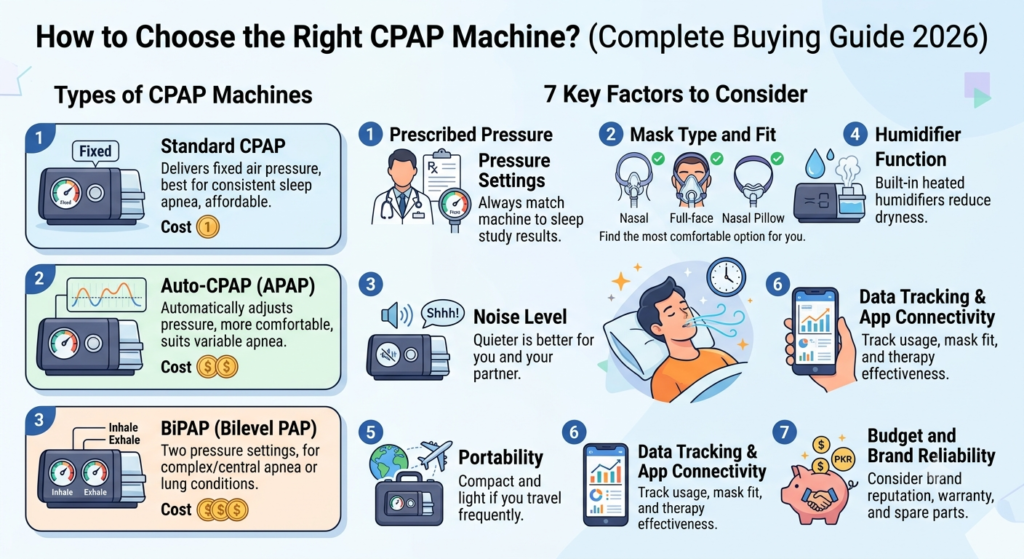
How to Choose the Right CPAP Machine? (Complete Buying Guide 2026)
Quick Answer: The right CPAP machine depends on five factors — your prescribed pressure range, mask compatibility, noise level, portability needs, and budget. Most people with straightforward sleep apnea do well with an Auto-CPAP (APAP) machine that has a built-in humidifier, while those with more complex breathing issues may need a BiPAP. Always match the machine to your sleep study results, not just to reviews or price.
If you’ve just been diagnosed with sleep apnea, or a doctor has recommended CPAP therapy, choosing the right machine can feel overwhelming. There are dozens of brands, multiple machine types, and countless mask options — and picking the wrong one can mean discomfort, poor sleep, and wasted money. This guide breaks down exactly what to look for so you can make a confident, informed decision.
What Is a CPAP Machine and Who Needs One?
A CPAP (Continuous Positive Airway Pressure) machine treats obstructive sleep apnea by delivering a steady stream of pressurized air through a mask, keeping your airway open while you sleep. It’s typically prescribed after a sleep study confirms that your breathing repeatedly stops or becomes shallow during sleep.
If you experience loud snoring, gasping for air at night, excessive daytime fatigue, or morning headaches, a doctor may recommend a sleep study followed by CPAP therapy.
Types of CPAP Machines: Which One Is Right for You?
There are three main types of positive airway pressure machines, and understanding the difference is the first step in choosing correctly.
1. Standard CPAP
Delivers a single, fixed air pressure throughout the night, as set by your doctor. It’s simple, reliable, and usually the most affordable option — ideal for people with consistent, uncomplicated sleep apnea.
2. Auto-CPAP (APAP)
Automatically adjusts air pressure throughout the night based on your breathing patterns. This is often more comfortable since it delivers only as much pressure as needed at any given moment. APAP machines tend to cost more but suit people whose apnea severity varies by sleep position or sleep stage.
3. BiPAP (Bilevel PAP)
Provides two pressure settings — one for inhaling and a lower one for exhaling. This is generally prescribed for more complex cases, such as central sleep apnea or certain lung and neuromuscular conditions, and is usually recommended only after a specialist evaluation.
| Machine Type | Best For | Pressure Adjustment | Typical Cost |
|---|---|---|---|
| Standard CPAP | Simple, consistent apnea | Fixed | Lowest |
| Auto-CPAP (APAP) | Variable apnea severity | Automatic | Mid-range |
| BiPAP | Complex/central apnea | Two-level | Highest |
7 Key Factors to Consider Before Buying a CPAP Machine
1. Prescribed Pressure Settings
Never buy a CPAP machine without a sleep study and a doctor’s prescription. The machine must be able to deliver the specific pressure range your sleep specialist recommends — buying based on guesswork or a friend’s recommendation can make therapy ineffective or unsafe.
2. Mask Type and Fit
The mask matters as much as the machine itself. There are three common types:
- Nasal mask — covers the nose only; good for most users
- Full-face mask — covers nose and mouth; better for mouth breathers
- Nasal pillow mask — small cushions that sit at the nostrils; most minimal and lightweight
A poor mask fit is one of the top reasons people abandon CPAP therapy, so trying different options (or asking your supplier about a trial period) is worth the effort.
3. Noise Level
Since the machine runs beside your bed all night, quieter is better — both for you and anyone sharing the room. Most modern machines operate at low decibel levels, but it’s worth checking specifications or reviews before buying.
4. Humidifier Function
A built-in heated humidifier reduces dryness in the nose and throat, which is especially useful in dry climates or during winter. Many mid-range and premium machines now include this as a standard feature rather than an add-on.
5. Portability
If you travel frequently, consider a compact or travel-specific CPAP machine. These are smaller and lighter, though they may have a higher per-unit cost compared to standard home machines.
6. Data Tracking and App Connectivity
Many newer machines connect via Bluetooth or Wi-Fi to a smartphone app, allowing you (and your doctor) to track usage hours, mask fit, and therapy effectiveness. This is useful for monitoring progress and adjusting treatment over time.
7. Budget and Brand Reliability
Prices vary widely based on brand and features. Two of the most recognized global brands are ResMed and Philips Respironics, while more budget-friendly Chinese-manufactured brands like BMC have also become popular for cost-conscious buyers. Before choosing based on price alone, check:
- Availability of spare parts and filters locally
- Warranty coverage
- After-sales service and technical support
For up-to-date pricing, you can check the CPAP machine price in Pakistan guide. If you’re based in a specific city, city-wise pricing can also help you compare local suppliers — see CPAP machine price in Karachi and CPAP machine price in Lahore for current rates.
Standard CPAP vs Auto-CPAP: Which Should You Choose?
This is one of the most common questions buyers ask. Here’s a simple way to decide:
- Choose Standard CPAP if: your sleep study shows a stable, predictable pressure need, and budget is a primary concern.
- Choose Auto-CPAP if: your pressure needs fluctuate (e.g., with sleep position, alcohol use, or weight changes), and you want a more adaptive, often more comfortable therapy experience.
Your sleep specialist is best positioned to make this call based on your sleep study data.
Common Mistakes to Avoid When Buying a CPAP Machine
- Skipping the sleep study and buying a machine based only on symptoms
- Choosing the cheapest option without checking warranty or service support
- Ignoring mask fit, which leads many people to quit therapy early
- Buying used machines without knowing usage history or hygiene condition
- Not checking humidity/filter compatibility, especially in dusty or dry environments
Frequently Asked Questions
Q: Do I need a prescription to buy a CPAP machine? Yes. A CPAP machine should be prescribed after a sleep study confirms sleep apnea and determines your required pressure settings. Buying without proper diagnosis can be ineffective or harmful.
Q: How long does it take to get used to a CPAP machine? Most people need anywhere from a few days to a few weeks to adjust. Choosing a comfortable mask and using humidification can significantly ease the adjustment period.
Q: Can I use a CPAP machine without electricity for long periods? Standard CPAP machines require continuous power. If power outages are a concern, look into DC-compatible machines or battery backup options designed for CPAP use.
Q: Auto-CPAP or Standard CPAP — which is better for beginners? There’s no universal answer; it depends on your sleep study results. Many doctors start beginners on Auto-CPAP because it adapts automatically, reducing the guesswork involved in manual pressure adjustment.
Q: How often should CPAP masks and filters be replaced? Masks are typically replaced every 3–6 months and filters every 1–2 months, though this varies by manufacturer and usage frequency. Regular cleaning also extends the lifespan of both.
Final Thoughts
Choosing the right CPAP machine isn’t about picking the most expensive or most popular option — it’s about matching the machine to your specific sleep study results, comfort needs, and lifestyle. Talk to your sleep specialist, test mask options where possible, and prioritize after-sales support and warranty over price alone. A well-chosen CPAP setup can be the difference between restless nights and genuinely restorative sleep.